By Karen Hanna
A company that has put a new spin on extrusion is rolling out a rotary table that will exponentially increase its technology’s production capacity.
Known as X2F — which stands for extrude-to-fill — the company and its technology of the same name employ a low-stress approach when it comes to materials. The company patented the machine to provide gentle treatment to some of the most delicate and demanding materials, from carbon-fiber-filled PEEK to polymethyl methacrylate.
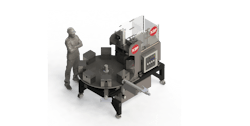
In the latest development, initially introduced a few months ago to address demand from automotive lens makers, X2F now offers a rotary table with automation that can be paired with the machine, CEO Michael Slowik said.
“We extrude one part into the mold, and then the insert, and then after that part is extruded in the mold cavity, it turns, and the next mold cavity gets filled with the extruder, and there’s a portion on there where there’s a pick arm, and that pick arm will take out the component, either the automotive lens or the electronic, before it then gets filled again,” he said.
Using special molds, the X2F machine performs a controlled-viscosity, low-pressure process that leverages aspects of extrusion with injection molding. To avoid producing shear, it uses electrically generated heat in lieu of the high pressures often used by injection molding machines (IMMs). A multipitch screw carries resins through multiple heat zones in pulses in a multi-step extrusion process of pack-hold-repack.
“It’s an entirely different approach to molding,” Slowik said.
Because it puts less pressure on resins — typically, 3,000 to 5,000 psi, compared with the 30,000 to 40,000 psi produced by IMMs — the X2F can handle an array of challenging materials. To suit some applications, the machine can operate at under 500 psi.
“Because we have a controlled-viscosity approach that happens at dramatically lower pressure compared to other techniques, we’re able to put more additives in our system, so ceramics, graphites, etc., that impart the thermal properties needed,” Slowik said.
Parts produced with such materials exhibit better characteristics when manufactured with the X2F machine, Slowik said.
Of particular interest are parts with optical characteristics or thermally conductive properties, electromagnetic shielding, encapsulated electronics and applications related to battery manufacturing.
Part weights can range from less than 2 grams to 300 grams, Slowik said.
“Key applications in electric vehicle batteries, metaverse hardware and mobile phones are driving customer engagement,” he said.
In addition to handling challenging materials, the X2F machine offers production advantages over other processes, such as conformal coating, that are used to make otherwise unmoldable parts. The potting process, for example, can be used to encapsulate electronics, but the parts might require a full day to cure; by contrast, the X2F machine produces comparable parts that are ready to go in seconds or minutes.
According to Slowik, the new rotary table can facilitate dramatic gains in throughputs.
“Our base machine I generally say [produces] about 150,000 to 200,000 units per year. … And the rotary platen gets us into the 1 [million] to 4 million units-per-year range.”
Demand for the machines is growing, Slowik said, and more innovations are on the way — including, possibly, multiple-extruder models to make parts as big as automotive bumpers.
To accommodate growing interest, the company is expanding its Colorado facility, where 10 to 20 people make X2F machines and design molds for them; customers also can contract X2F to make parts on their behalf.
“There’s a place in the market for traditional injection molding, but we’re looking for applications where we can provide a step change in performance [of] 30 to 40 percent beyond what a customer can get today on some aspects,” Slowik said.
Contact:
About the Author
Karen Hanna
Senior Staff Reporter
Senior Staff Reporter Karen Hanna covers injection molding, molds and tooling, processors, workforce and other topics, and writes features including In Other Words and Problem Solved for Plastics Machinery & Manufacturing, Plastics Recycling and The Journal of Blow Molding. She has more than 15 years of experience in daily and magazine journalism.